
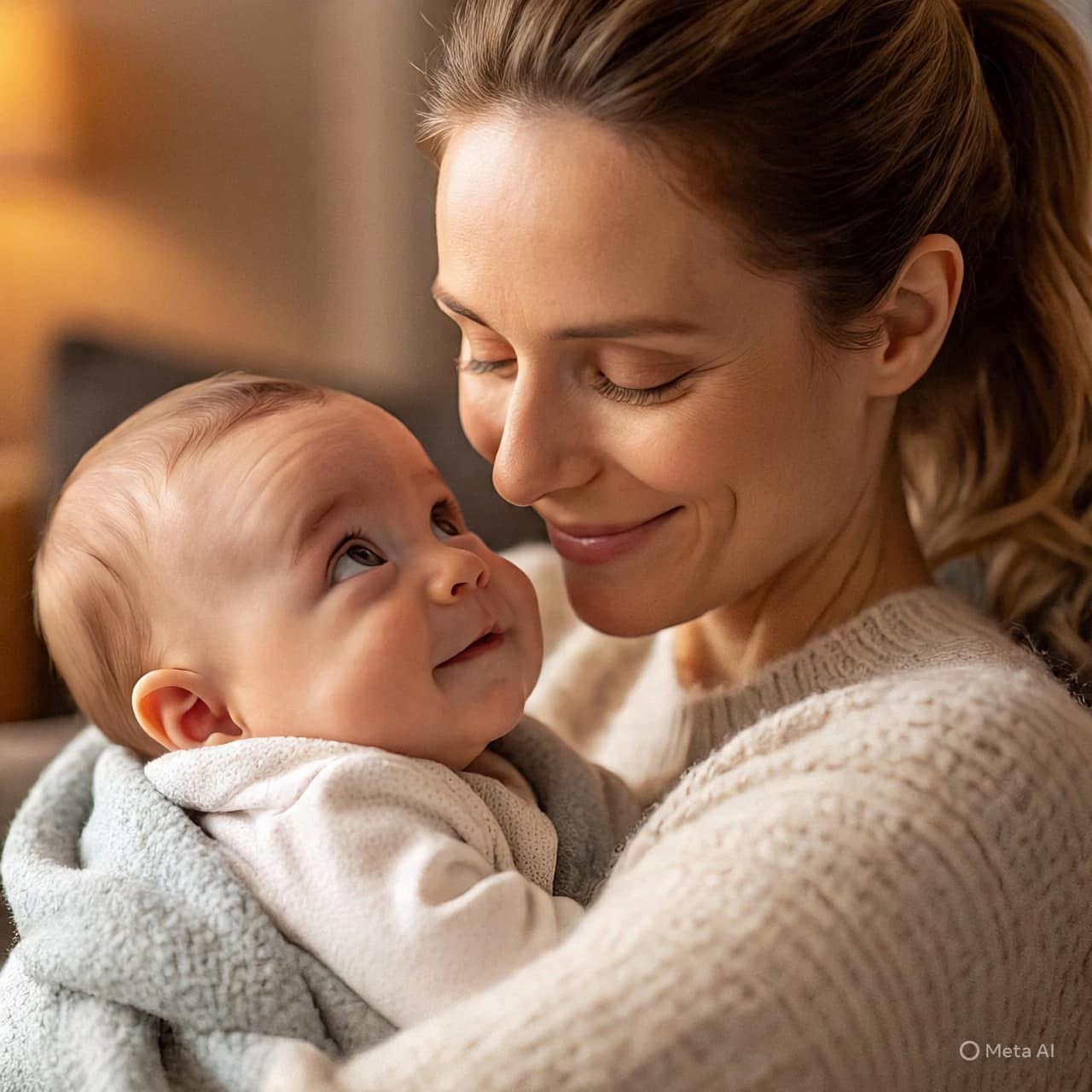
In the love affair between infant and mother, the mother playfully teases the infant into connection, expresses delight, responds with a kind of knowing pleasure that feels spontaneous to the infant, but that she was waiting for all along. There’s mutual gazing, a back-and-forth, a dance. It’s a blissful time in their mutual love affair—a time when the baby feels that if he turns away, someone will be there, watching, waiting, ready to bring him back into connection.
The good mother seduces her baby in the most loving way: through her care, her presence, her playful ministrations—peek-a-boo games, gentle stroking, warm eye contact, soothing touch. She regulates the baby’s stimulation in a way that makes excitement feel safe. For sensitive infants, the stimulation can sometimes become too much—they need to turn away. And a mother who is attuned, who can find just the right rhythm, will know when to pause, when to re-engage, when to wait. This is the beginning of a shared rhythm—the dance of “hide-and-seek,” “lost-and-found,” the mutual pull of attention and affection.
Some babies need more of this dance. Some need less. But the ones who get the right kind of rhythm—one attuned to their inner world—are given a template for pleasure in mutual engagement, for the joy of being sought, found, and seen.
As adults, many of us long to refind that experience—or to have it for the first time. We want to feel that someone will chase after us, reach out for us, try to find us when we pull away. Sometimes we withdraw, not because we don’t care, but because we’re afraid the other won’t join the dance with us. We might unconsciously play hard to get—not out of manipulation, but to protect ourselves from the unbearable feeling of being too much, or worse, not enough to want to be found.
Underneath, we may be hoping: Please come after me. Prove that you want me. Show me I matter enough to pull me back in when I’ve turned away.
These wishes often go unspoken. Sometimes we’re not even aware of them. They can feel young, even childish, and that can be embarrassing. But they are not uncommon. In fact, wanting to be pursued is a common way of coping with the fear of rejection, and of expressing the wish to be desired—not just physically, but emotionally and existentially.
Sometimes this dynamic shows up in therapy, too. Clients will come in and tell me they can’t say certain things unless I pull it out of them. They want me to guess. They want me to chase their truth, to prove I care enough to pursue it. Sometimes it feels playful, like a game. Other times, it feels like a challenge or a test. But it always speaks to an unmet need—for someone to reach inside, to pull them out, to prove that what’s inside of them is worth knowing, worth staying for.
There’s often a wish to be penetrated—not physically, but emotionally. To be known deeply. To feel that our enigmatic inner world is a mystery worth uncovering.
When the wish to be run after is hidden or disowned, it can backfire. We may pull away, hoping to be pursued—but if the other doesn’t chase us, we feel rejected. Or the person we long to engage becomes confused, sensing distance or coldness. They may interpret our withdrawal as disinterest or dismissal, when really, we’re silently asking: Will you come find me?
These longings are young and primitive. They stir feelings of play, desire, excitement, vulnerability. And they’re not inherently problematic. What’s important is learning how to express these dynamics in ways that invite mutual enjoyment and connection, rather than becoming power struggles, tests, or emotional traps.
When both people can engage in the dance—pursuing and being pursued, hiding and being found, pulling and being pulled—it becomes an arena for discovery. There’s room for surprise, for mystery, for that charged feeling of intensity that makes us feel alive, creative, and emotionally awake.
This is the ebb and flow that fuels adult love: the rhythm of charge and rest, expansion and contraction, closeness and space. When we find someone who can match our rhythm—or learn it with us—relationships become more than just safe havens. They become sources of vitality, drawing out parts of ourselves we didn’t know we could access on our own.
Leave A Comment
You must be logged in to post a comment.